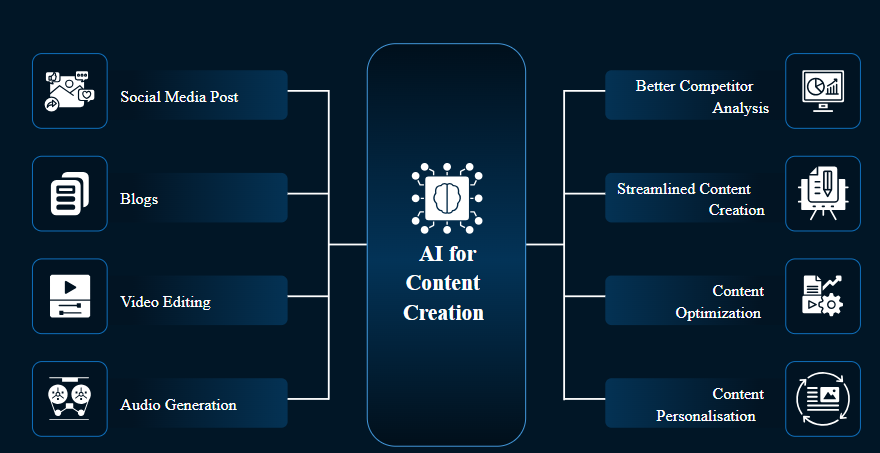

Generative AI reframes content creation as a data-driven, iterative system rather than a linear sequence. It accelerates idea generation, drafting, and revision through prompts, provenance, and rapid variant testing. Tools, costs, and ethics shape adoption, while measurable quality gates and attribution preserve trust. Personalization and autonomous production expand reach, yet verification and human judgment remain essential to guard originality and audience autonomy. The next move hinges on scalable governance that blends efficiency with accountable creativity.
How Generative AI Reframes Content Creation Foundations
Generative AI redefines the foundations of content creation by shifting from manual, linear workflows to data-driven, iterative systems that optimize idea generation, drafting, and revision at scale.
The role of prompts shapes intent, guides outputs, and accelerates alignment with strategy, while data provenance ensures traceable sources and reproducible results.
This frame supports autonomous teams, enabling disciplined experimentation and scalable, freedom-enabled creativity.
Evaluating Tools, Costs, and Ethics for Creators
The debate: copyright, ownership; risk: hallucinations, misinformation guide policy choices, risk mitigation, and transparency.
Decisions emphasize measurable ROI, ethical guardrails, and adaptable architectures for resilient, future-ready content ecosystems.
See also: techoelitecom
From Ideas to Outputs: Speed, Personalization, and Quality
Personalization strategies tailor relevance without sacrificing consistency, enabling rapid testing of variants.
Strategic architecture aligns workflows with measurable quality gates, optimizing iteration cycles for creators seeking freedom through autonomous, data-driven content generation.
Crafting Responsible Workflows: Verification, Attribution, and Human Touch
This phase builds on the acceleration and personalization framework by embedding verification, attribution, and human oversight into the content lifecycle.
The approach formalizes verification workflows to validate outputs against standards, while attribution practices clearly assign authorship and provenance.
Strategically integrated checks enable agile governance, reduce risk, and preserve creativity, ensuring responsible automation that respects independent thought, editors’ judgment, and audience autonomy.
Frequently Asked Questions
How Can Ai-Generated Content Impact Creator Royalties and Ownership Rights?
AI-generated content may shift royalties, but ownership clarity remains essential; creators should secure rights to inputs, outputs, and models. This strategic, forward-thinking approach reduces ambiguity, supports freedom, and guides negotiations in evolving licensing, attribution, and revenue structures.
What Skills Should Creators Learn to Stay Competitive With AI Tools?
“Knowledge is power,” asserts the analyst: creators should master skills integration and adapt to creative tooling, staying strategic, technical, and forward-thinking to preserve autonomy while leveraging AI. This approach remains essential for freedom-seeking professionals.
Can AI Replace the Need for Human Editors and Influencers?
AI editors cannot fully replace humans; they augment editors and influencers. They optimize editing workflows, reinforce influencer ethics, and clarify content ownership, while preserving strategic decision-making, creative freedom, and accountability in a forward-thinking, technically grounded framework.
How Do Audiences Perceive Authenticity in Ai-Assisted Content?
Audience perception of AI-assisted content hinges on transparency, verifiable provenance, and consistent quality; authenticity trust grows when disclosures accompany outputs, enabling informed judgments while audiences embrace freedom to curate trusted, technically grounded experiences with clear provenance.
What Are Best Practices for Disclosing AI Involvement to Audiences?
“Spot on” transparent disclosures should accompany AI-generated content to preserve audience trust; best practices include clear labeling, accessible explanations of methods, and ongoing auditing. The approach is strategic, technical, forward-thinking, and freedom-oriented for audiences.
Conclusion
Generative AI reshapes content creation as a strategic, data-driven discipline—where prompts, provenance, and rapid iteration converge to amplify idea generation and output quality. The theory that AI merely speeds up workflows is insufficient; it reframes authorship as collaborative synthesis between human judgment and machine insight. By rigorously validating sources, balancing automation with human oversight, and transparently managing costs and ethics, creators achieve scalable personalization, measurable quality gates, and sustainable ROI in an evolving media landscape.